Punjab Examination Commission of Textbook and Assessment (PECTA) 2026

Grade 9 Mathematics Pairing Scheme 2026

Complete paper pattern and question distribution for the Punjab Board Annual Examination 2026. Understand the exact marks allocation and chapter-wise question distribution for effective preparation.
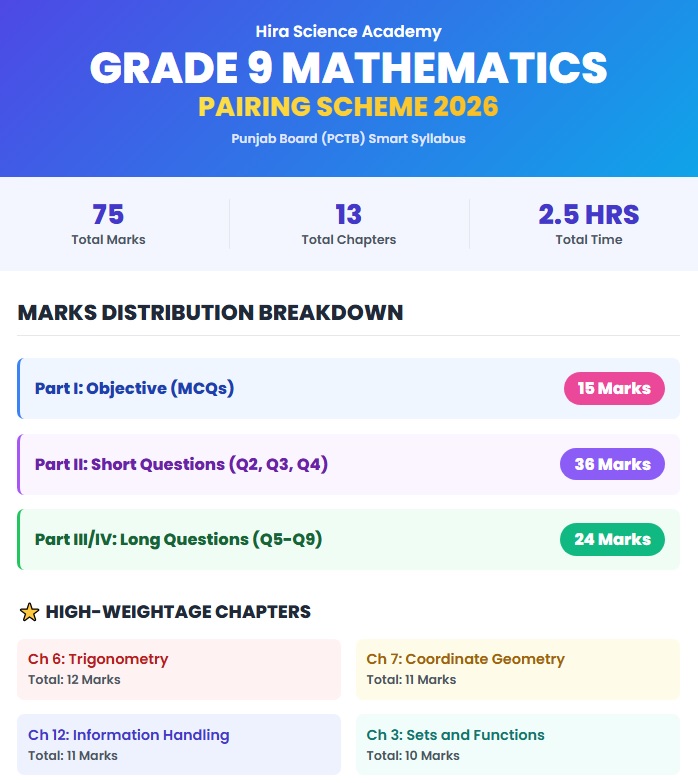
Grade 9 Mathematics Pairing Scheme 2026

Grade 9 Mathematics Pairing Scheme 2026

This official pairing scheme outlines the complete structure of the Annual Examination 2026 for Grade 9 Mathematics, including marks distribution, question types, and chapter-wise allocation.

Note: Total marks for the paper: 75 marks. Time allocation: 2:30 hours. Objective Type: 20 minutes, Subjective Type: 2:10 hours.

Grade 9 Math Pairing Scheme 2026

Paper Structure Overview

Total Marks: 75

Objective: 15 marks + Subjective: 60 marks

Total Time: 2:30 hours

Objective: 20 min + Subjective: 2:10 hours

Objective Type (MCQs) - 15 Marks

Question Description Marks
Q-1 15 Multiple Choice Questions (MCQs) from entire textbook 1 Γ— 15 = 15
Distribution: One MCQ each from chapters 1, 2, 5, 7, 9, 10, 11, 12, and 13. Two MCQs each from chapters 3, 4 & 6.

Subjective Type - 60 Marks

Part-I: Short Questions (12 + 12 + 12 = 36 Marks)
Q-2: Attempt any 6 out of 9 questions (2 Γ— 6 = 12 marks)

Two short questions from each of chapters 1, 2, 3 and 4, and one from chapter 5.

Q-3: Attempt any 6 out of 9 questions (2 Γ— 6 = 12 marks)

Three short questions from each of chapters 6, 7 and 9.

Q-4: Attempt any 6 out of 9 questions (2 Γ— 6 = 12 marks)

Two short questions from each of chapters 10, 11, and 13, and three from chapter 12.

Part-II: Long Questions (Attempt 2 out of 3 questions) - 16 Marks
Question Chapter Parts Marks
Q-5 Chapter 1 & 2 (a) From Chapter 1, (b) From Chapter 2 8 (4+4)
Q-6 Chapter 3 & 4 (a) From Chapter 3, (b) From Chapter 4 8 (4+4)
Q-7 Chapter 5 & 6 (a) From Chapter 5, (b) From Chapter 6 8 (4+4)
Students attempt any 2 questions out of Q-5, Q-6, Q-7 (2 Γ— 8 = 16 marks)
Part-III: Long Questions (Attempt 1 out of 2 questions) - 8 Marks
Question Chapter Parts Marks
Q-8 Mixed Chapters (a) From Chapter 7 or 10, (b) From Chapter 9 8 (4+4)
Q-9 Mixed Chapters (a) From Chapter 12, (b) From Chapter 11 or 13 8 (4+4)
Students attempt any 1 question out of Q-8, Q-9 (1 Γ— 8 = 8 marks)

Chapter-wise Marks Distribution

Chapter Topic MCQs Short Qs Long Qs Total Marks
1 Real Numbers 1 2 4 7
2 Logarithms 1 2 4 7
3 Sets and Functions 2 2 4 8
4 Factorization 2 2 4 8
5 Linear Equations 1 1 4 6
6 Trigonometry 2 3 4 9
7 Coordinate Geometry 1 3 4 8
9 Similar Figures 1 3 4 8
10 Graphs of Functions 1 2 4 7
11 Loci and Construction 1 2 4 7
12 Information Handling 1 3 4 8
13 Probability 1 2 4 7
Total 15 36 24 75

Preparation Strategy

Focus on High-Weightage Chapters

Chapters 3, 4, 6, 7, 9, and 12 carry more marks. Allocate study time accordingly.

Practice Selective Attempts

In subjective parts, you can attempt only required questions. Choose your strongest areas.

Time Management

Allocate only 20 minutes for MCQs. Use remaining time strategically for subjective questions.

Essential Resources

Reduced Syllabus

View the complete SMART / Reduced Syllabus for Grade 9 Mathematics with detailed unit-wise excluded content for focused preparation.

View Syllabus

Model Paper

Practice with our specially designed Model Paper based on the SMART syllabus for Grade 9 Mathematics. Ideal for exam-style preparation.

View Paper

Class Notes

Access comprehensive and easy-to-understand Class Notes covering all topics included in the SMART syllabus for Grade 9 Mathematics.

View Notes

Explore Learning Resources Across All Grades

From structured grade notes to exam preparation material, find everything you need to progress academicallyβ€”all organized for your ease.